

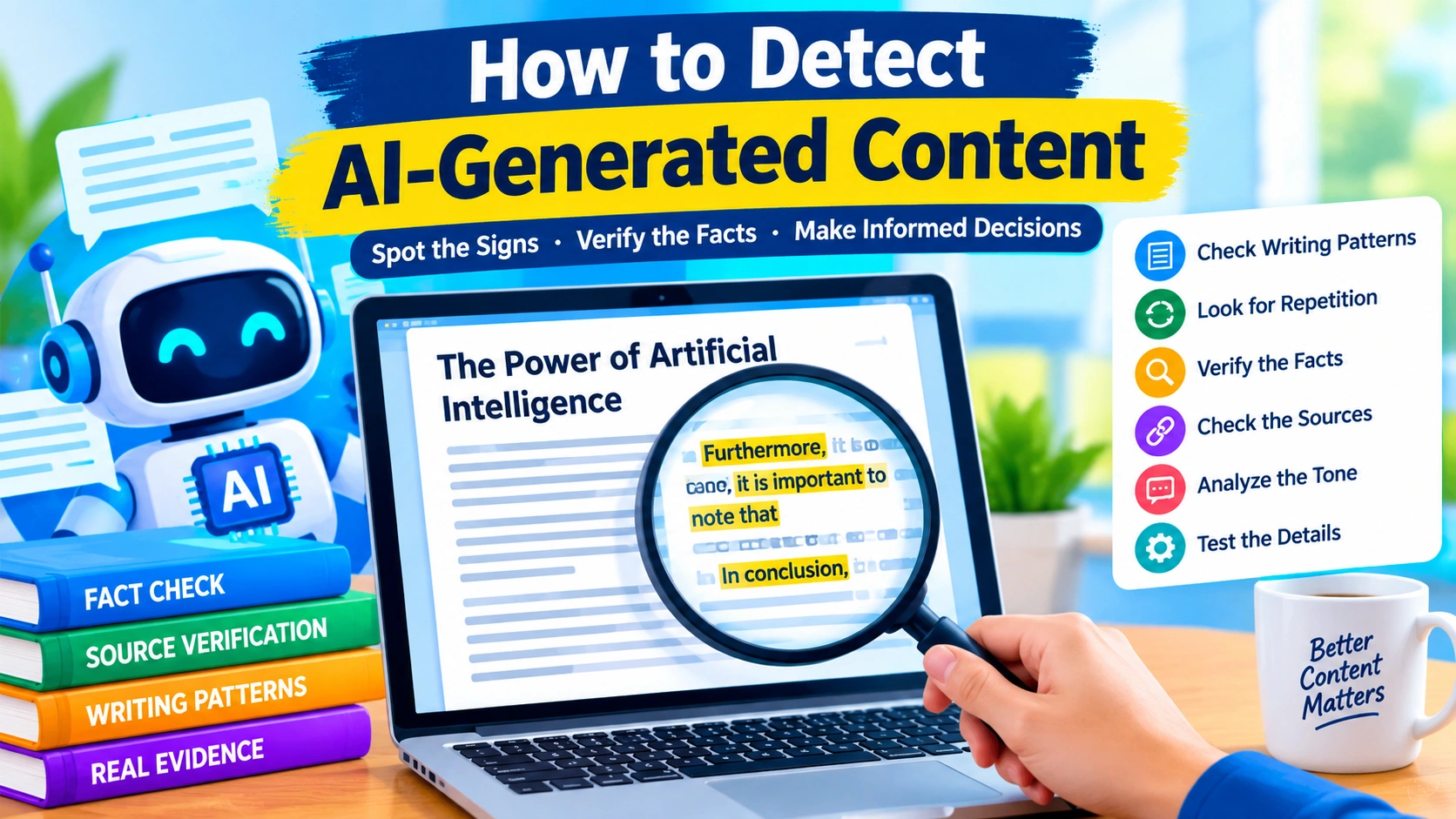
AI writing tools have made it easier than ever to create articles, essays, product descriptions, social media posts, and other types of content. While AI-generated content can be useful, it can also be difficult to distinguish from human writing.
Whether you are a teacher checking an assignment, an editor reviewing an article, a website owner maintaining content quality, or simply curious about a suspicious piece of text, knowing how to detect AI-generated content can help you evaluate what you are reading.
However, there is one important limitation: there is no reliable method that can prove with certainty that a particular piece of text was written by AI. AI detectors can produce both false positives and false negatives, so they should be treated as evidence rather than definitive proof.
This guide explains practical ways to identify potential AI-generated content and how to verify your findings.
What Is AI-Generated Content?
AI-generated content is text created partly or entirely by an artificial intelligence system. Modern AI tools can produce surprisingly natural writing based on a short prompt.
AI can generate:
- Blog articles
- News summaries
- Essays
- Product descriptions
- Emails
- Social media posts
- Reviews
- Website copy
- Technical documentation
- Marketing content
- Answers to questions
Some content may be generated entirely by AI, while other content is written by a person and then improved, rewritten, or expanded using AI.
This makes detection more difficult because human and AI writing can exist together in the same document.
Why Is AI-Generated Content Difficult to Detect?
Older AI-generated text often had obvious patterns. Modern language models are much better at producing natural sentences and adapting their writing style.
A human writer can also produce text that looks highly predictable, while AI-assisted writing can be heavily edited by a person.
For this reason, simply reading an article and saying “this sounds like AI” is not enough.
Instead, look for multiple signals.
1. Look for Repetitive Sentence Patterns
One of the easiest things to notice is repetitive sentence structure.
AI-generated writing may repeatedly use similar patterns such as:
“First, you should…”
“Another important factor is…”
“It is also important to…”
“Finally, make sure…”
Using these expressions occasionally is normal. The problem occurs when similar structures appear throughout an entire article.
Human writers tend to vary sentence length, transitions, vocabulary, and paragraph structure more naturally.
What to check
Look for:
- Repeated sentence openings
- Similar paragraph structures
- Repeated transition words
- Excessive use of numbered explanations
- Similar sentence lengths
- Frequent conclusions after every section
One pattern alone does not prove AI authorship, but several patterns together can be a useful warning sign.
2. Check for Generic Introductions
AI-generated articles frequently begin with broad statements that could apply to almost any topic.
For example:
“In today’s digital world, technology plays an important role in our daily lives.”
This type of introduction is not necessarily AI-generated. Humans use generic introductions too.
However, if an article contains several paragraphs of general statements without providing specific information, examples, experiences, or evidence, it may indicate that the content was generated or heavily assisted by AI.
A stronger article usually gets to the subject quickly.
Instead of several paragraphs explaining why technology is important, a useful article might immediately explain the specific problem, solution, or procedure.
3. Look for Excessive Use of Transition Words
AI systems often use transition phrases to make content appear organized.
Common examples include:
- Furthermore
- Moreover
- Additionally
- In addition
- However
- Therefore
- On the other hand
- As a result
- In conclusion
- It is important to note
These words are perfectly normal in human writing.
The warning sign is overuse.
If almost every paragraph begins with a formal transition phrase, the writing may have been generated or heavily edited by an AI tool.
4. Examine the Level of Specificity
AI-generated content can sometimes sound informative while providing surprisingly few concrete details.
For example, an AI-generated paragraph might say:
“Keeping your computer updated can improve security, performance, and compatibility.”
That statement is reasonable, but it does not explain:
- Which updates?
- Which Windows version?
- What problems can occur?
- Which settings should be changed?
- What should the reader do if the update fails?
High-quality human content often includes specific observations, examples, instructions, measurements, or experiences.
When analyzing suspicious content, ask:
Does this article actually provide useful evidence, or does it mostly make general statements?
5. Check for Unusual Repetition
AI-generated content may repeat the same idea using different wording.
For example, an article might explain three times that updating drivers can improve hardware performance.
This can make an article appear longer without adding much information.
Look for:
- Repeated conclusions
- Repeated definitions
- Duplicate explanations
- Sections that say nearly the same thing
- Summary paragraphs that simply repeat earlier content
Repetition can occur in human writing as well, particularly in poorly edited articles, so it should not be considered proof.
6. Analyze the Tone and Vocabulary
Some AI-generated content has an unusually consistent tone.
For example, an article may remain perfectly formal from beginning to end, with very little variation.
It may also use words such as:
- comprehensive
- crucial
- essential
- seamless
- robust
- leverage
- utilize
- optimize
- furthermore
- significant
Again, these words are not evidence of AI by themselves.
The important factor is the overall pattern.
If the vocabulary feels unnecessarily formal for the intended audience and the article consistently uses polished corporate language, AI assistance is one possibility.
7. Look for Lack of Personal Experience
Personal experience is often difficult for AI to reproduce authentically unless the writer provides the underlying information.
For example, a human technology writer might say:
“I encountered this problem after installing a Windows driver update. Device Manager showed the adapter with a yellow warning icon, and reinstalling the previous driver fixed the problem.”
This contains specific observations.
Generic AI-generated content may instead say:
“Users may encounter various issues after updating their drivers. In such cases, reinstalling or updating the driver may resolve the problem.”
The second statement sounds reasonable but contains little firsthand detail.
When reviewing content, look for:
- Personal observations
- Specific testing results
- Real examples
- Screenshots
- Dates
- Version numbers
- Specific error messages
- Practical limitations
These details can make content easier to evaluate.
8. Verify Facts and Examples
One of the strongest ways to evaluate suspicious AI content is to fact-check it.
AI systems can produce convincing but incorrect information.
This can include:
- Incorrect software features
- Fake product specifications
- Wrong URLs
- Incorrect dates
- Misidentified companies
- Nonexistent settings
- Invented statistics
- Incorrect technical instructions
- Fake citations
For example, an article might claim that a particular Windows setting exists when it does not.
Instead of asking only:
“Does this sound like AI?”
ask:
“Can I verify what this article claims?”
Fact-checking is often more useful than attempting to identify the writing style alone.
9. Check Links and Citations
If the content contains references, inspect them carefully.
AI-generated content may occasionally provide citations that look legitimate but do not actually support the claim.
Check whether:
- The source exists.
- The source discusses the subject.
- The quoted information actually appears there.
- The publication date makes sense.
- The link leads to the claimed website.
- The statistics match the original source.
A suspicious citation is a much stronger reason for investigation than an unusual writing style.
10. Use AI Detection Tools Carefully
Several online services attempt to estimate whether text was generated by AI.
These tools typically analyze characteristics such as:
- Predictability of words
- Sentence patterns
- Vocabulary
- Writing structure
- Statistical patterns
However, their results should not be treated as definitive proof.
An AI detector might classify human writing as AI-generated.
It can also fail to identify AI-generated writing, particularly when the text has been edited or paraphrased.
Why false positives happen
A person who writes in a simple, formal, or highly structured style may produce text that resembles AI-generated writing.
This is especially important when evaluating:
- Students
- Non-native English writers
- Technical writers
- People using grammar tools
- People with a formal writing style
Therefore, an AI detector score should be considered one signal among several.
11. Compare the Writing With Previous Work
If you have access to the author’s previous writing, compare the documents.
This can be extremely useful.
Look at:
- Vocabulary
- Sentence length
- Grammar patterns
- Punctuation
- Paragraph structure
- Typical mistakes
- Tone
- Level of technical knowledge
For example, if someone’s previous articles contain short sentences, informal language, and occasional grammatical errors, but a new article suddenly uses highly polished academic language, that difference may justify closer examination.
However, a change in writing style does not automatically mean AI was used. The author could have edited the document, used a professional editor, or intentionally changed their style.
12. Check Document History When Available
For important documents, metadata and revision history can provide additional evidence.
Depending on the platform, you may be able to see:
- Creation time
- Revision history
- Major editing changes
- Copy-and-paste activity
- Document versions
- Author contributions
For example, a document that appears to have been written in a few minutes and contains thousands of polished words may deserve additional investigation.
This information is more useful when combined with the actual writing.
13. Look for Sudden Changes in Style
AI-assisted content may contain noticeable differences between sections.
For example:
Section A
Short sentences. Simple vocabulary. Several grammatical mistakes.
Section B
Long, polished sentences. Perfect grammar. Highly structured explanations.
Section C
Informal language with personal opinions.
Such inconsistencies can indicate that different sources or writing methods were combined.
However, they can also occur when multiple people collaborate on the same document.
14. Examine Technical Content Closely
Technical articles can be particularly easy to verify.
Suppose an article explains how to fix a Windows problem.
Don’t just evaluate the writing. Test the instructions.
Check:
- Do the menu names actually exist?
- Are the Windows settings correct?
- Does the command work?
- Is the registry path valid?
- Does the software feature exist?
- Does the suggested solution actually fix the problem?
For technology websites, practical testing is often more valuable than an AI detector score.
AI Detection vs. Human Review
The best approach is usually to combine multiple methods.
| Method | Usefulness |
|---|---|
| AI detector | Medium |
| Writing-style analysis | Medium |
| Fact checking | High |
| Source verification | High |
| Comparing previous work | High |
| Testing technical instructions | Very high |
| Revision history | Very high |
| Author interview | Very high |
No single method is perfect.
Can AI Detectors Prove That Content Was AI-Generated?
No.
AI detection tools generally provide a probability or classification rather than definitive proof.
For example, a detector might report that a document has a high likelihood of being AI-generated. That result should be interpreted as:
“This text has characteristics commonly associated with AI-generated writing.”
It should not automatically be interpreted as:
“AI definitely wrote this document.”
This distinction is important because false accusations can have serious consequences.
How to Detect AI-Generated Content on a Website
Website owners can use a broader evaluation process.
If you suspect that an article was generated by AI, check:
1. Originality
Search distinctive sentences or claims to determine whether the content appears elsewhere.
2. Accuracy
Verify technical information, statistics, dates, and product specifications.
3. Author information
Check whether the author has relevant experience or expertise.
4. Sources
Inspect citations and outbound links.
5. Writing quality
Look for repetition, generic explanations, and unnatural formatting.
6. Practical value
Ask whether the article actually solves the reader’s problem.
7. Firsthand evidence
Look for original testing, screenshots, examples, measurements, and observations.
This approach is much more useful for SEO-focused websites than relying exclusively on an AI detector.
Does Google Penalize AI-Generated Content?
Using AI to assist with content creation is not automatically the same as producing low-quality content.
The more important question is whether the content is useful, accurate, original, and created for people rather than simply produced to manipulate search rankings.
For website owners, the safest strategy is to use AI as an assistant rather than a replacement for editorial judgment.
For example, AI can help you:
- Generate article outlines
- Brainstorm topics
- Improve grammar
- Rewrite unclear sentences
- Explain technical concepts
- Create FAQ ideas
- Suggest titles
- Organize information
A human should still verify the facts, add original insights, test instructions, and make the final editorial decisions.
How to Make AI-Assisted Content More Valuable
If you use AI to help create website content, don’t simply publish the first generated draft.
Instead, improve it by adding information that comes from real research or experience.
Add original examples
Explain what happened during actual testing.
Add screenshots
Screenshots can demonstrate the exact settings or error messages discussed in an article.
Add specific instructions
Tell readers exactly what to click, type, or change.
Verify every important claim
Check information against reliable sources.
Remove unnecessary repetition
Make every section provide something useful.
Add limitations
Explain when a solution may not work.
Update outdated information
Software and operating systems change frequently.
This process transforms generic AI-assisted writing into more useful editorial content.
A Simple AI Content Detection Checklist
When you suspect that an article was generated by AI, use this checklist:
- Does the introduction sound overly generic?
- Are sentence structures unusually repetitive?
- Are transition words used excessively?
- Does the article repeat the same ideas?
- Are there few concrete examples?
- Are personal experiences missing?
- Are citations accurate?
- Are technical claims verifiable?
- Do links actually work?
- Does the writing differ significantly from the author’s previous work?
- Are there unusual changes in tone?
- Has the content been tested in the real world?
- Does an AI detection tool identify potential AI characteristics?
The more independent signals you find, the stronger your reason for further investigation.
Common Mistakes When Detecting AI Content
Mistake 1: Trusting an AI Detector Completely
A detector is an analytical tool, not a perfect judge.
Mistake 2: Assuming Good Grammar Means AI
Human writers can produce excellent grammar.
Mistake 3: Assuming Generic Writing Is Always AI
Many human writers use generic templates.
Mistake 4: Ignoring Fact Checking
Incorrect information can be more significant than whether AI was involved.
Mistake 5: Looking Only at One Paragraph
Analyze the entire document for patterns.
Mistake 6: Treating AI Assistance as the Same as Full AI Generation
A human may use AI for brainstorming or proofreading while writing the actual article themselves.
Frequently Asked Questions
Can you tell if something was written by ChatGPT?
You can look for patterns associated with AI-generated writing, but you generally cannot determine with certainty that ChatGPT produced a particular piece of text simply by reading it.
Are AI detectors accurate?
AI detectors can be useful as one source of evidence, but they can produce false positives and false negatives. Their results should be interpreted cautiously.
Can AI-generated content pass an AI detector?
Yes. Editing, rewriting, paraphrasing, and changes in writing style can make AI-generated text harder for detection systems to identify.
Can human writing be incorrectly detected as AI?
Yes. Formal, predictable, or highly structured human writing can sometimes be classified as AI-generated.
What is the best way to detect AI content?
Use multiple methods: analyze writing patterns, verify facts, inspect sources, compare previous writing, examine revision history when available, and use AI detectors only as supporting evidence.
Should website owners remove AI-generated content?
Not necessarily. The more important issue is whether the content provides accurate, original, useful information. AI-assisted content can be valuable when it is properly researched, edited, and verified.
Final Thoughts
Detecting AI-generated content is becoming increasingly difficult as artificial intelligence produces more natural writing. There is no single phrase, grammar pattern, or detection tool that can reliably prove who wrote a piece of text.
The most effective approach is to combine several signals.
Look at writing patterns, check for repetitive or generic language, verify facts, inspect citations, compare the text with previous work, and test technical claims when possible. AI detection tools can provide another data point, but their results should never be treated as absolute proof.
For publishers and website owners, the better goal is not simply to eliminate AI-generated text. Instead, focus on creating accurate, original, useful, and genuinely helpful content—regardless of whether AI was involved in the drafting process.
I can also create a 60-character SEO title, 145-character meta description, FAQ schema ideas, and a bright 16:9 featured-image prompt for this article.