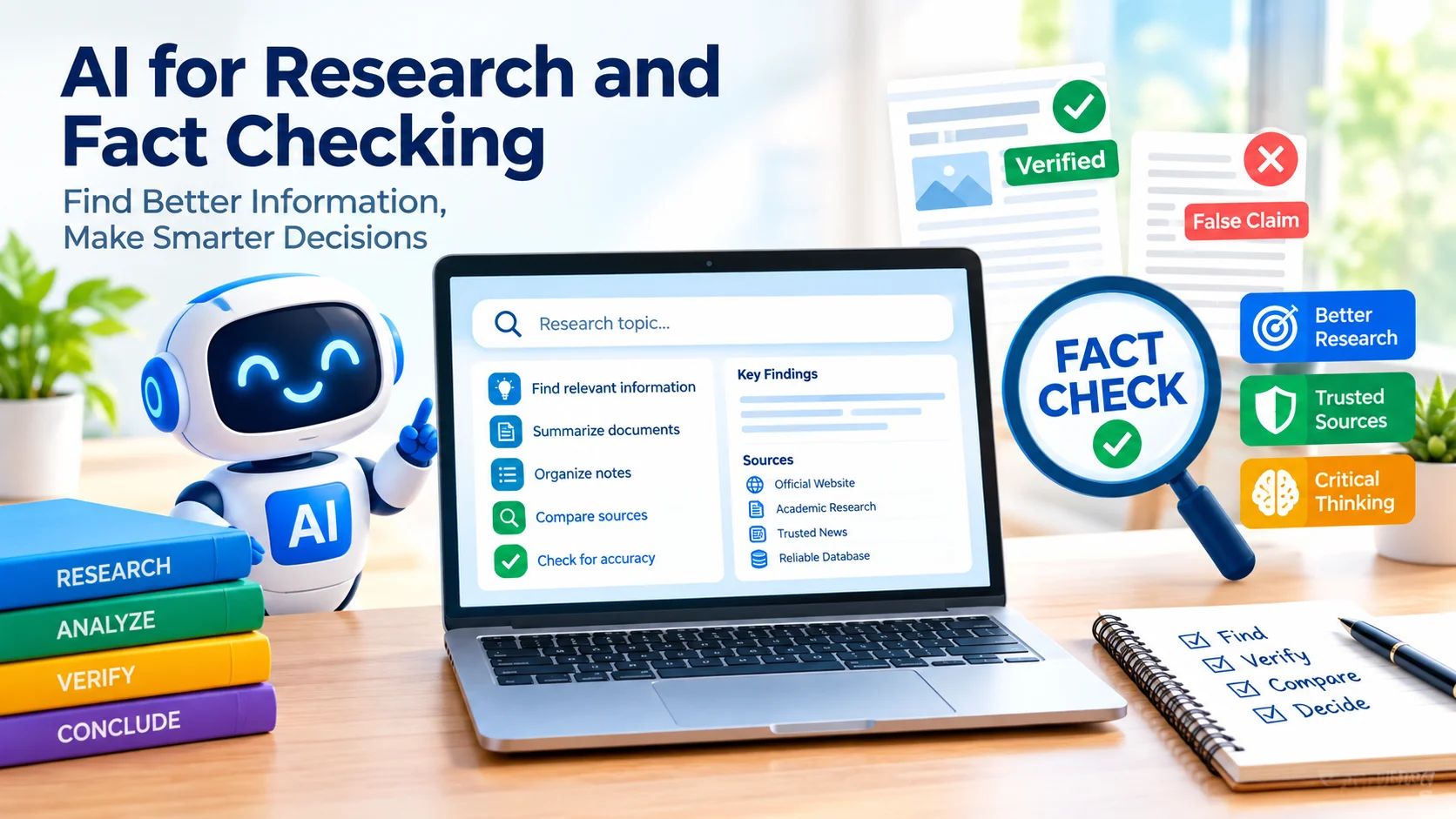
Artificial intelligence is changing the way people find, analyze, and verify information online. AI for Research and Fact Checking can help users organize large amounts of information, identify relevant sources, summarize documents, and spot claims that require further verification.
However, AI should not be treated as an automatic replacement for reliable sources. AI systems can make mistakes, misunderstand context, or provide information that is outdated. The best approach is to use AI as a research assistant while checking important claims against trustworthy sources.
What Is AI for Research and Fact Checking?
AI for research and fact checking refers to using artificial intelligence tools to assist with information discovery, source analysis, claim verification, and research organization.
Instead of manually reviewing dozens of pages, users can use AI to:
- Generate research questions
- Find relevant topics and keywords
- Summarize lengthy documents
- Compare information from multiple sources
- Identify claims that need verification
- Explain complicated concepts
- Organize notes and research findings
- Highlight possible contradictions
The final decision about whether information is accurate should still be based on reliable evidence.
How AI Can Help With Research
AI can make the early stages of research more efficient. For example, you can give an AI tool a research topic and ask it to identify important subtopics, terminology, and questions worth investigating.
1. Generate Research Questions
Start with a broad topic and ask AI to break it into specific questions.
For example, instead of researching “Windows security,” you could investigate:
- How does Windows protect user accounts?
- What are common Windows security risks?
- How does Microsoft Defender detect malware?
- Which Windows security settings should users review?
This creates a structured research plan.
2. Summarize Long Documents
AI can help summarize reports, studies, articles, and other lengthy documents. This can save time when you need to understand the main points before reading the original source in detail.
A summary should be treated as an overview rather than a replacement for the original document.
3. Organize Research Notes
AI can turn unorganized notes into categories, tables, outlines, or question-and-answer formats. This is especially useful for large research projects.
For example, information can be organized into:
| Category | Information |
|---|---|
| Claim | What is being stated |
| Source | Where the claim came from |
| Evidence | Data supporting the claim |
| Date | When the information was published |
| Status | Verified, disputed, or unconfirmed |
How AI Can Help With Fact Checking
Fact checking requires more than asking an AI whether something is true. A better process is to identify the claim, find authoritative evidence, and compare the evidence with the original statement.
Step 1: Identify the Exact Claim
Separate opinions from factual claims.
For example:
“This software is the fastest solution available.”
This contains a potentially subjective claim.
A more specific claim might be:
“This software was released in 2026.”
The second statement can potentially be verified using an official announcement or other reliable source.
Step 2: Find the Original Source
Whenever possible, locate where the information originally came from.
Look for:
- Official government websites
- University websites
- Scientific publications
- Official company documentation
- Reputable news organizations
- Primary research
- Original datasets
A secondary article can be useful, but the original source is often better for verification.
Step 3: Check the Publication Date
Old information can become misleading when circumstances change.
Always check whether the source is current enough for the topic. Software features, laws, prices, statistics, security threats, and product specifications can change quickly.
Step 4: Compare Multiple Sources
Do not rely on a single webpage for important claims.
Compare information from several independent sources and look for agreement or disagreement.
If sources disagree, investigate why. Differences may result from publication dates, different methodologies, definitions, or incomplete information.
Step 5: Verify the Evidence
Ask whether the source actually supports the claim.
A webpage mentioning a subject does not necessarily prove a statement about it. Check the specific text, data, methodology, or documentation supporting the claim.
AI Fact Checking Mistakes to Avoid
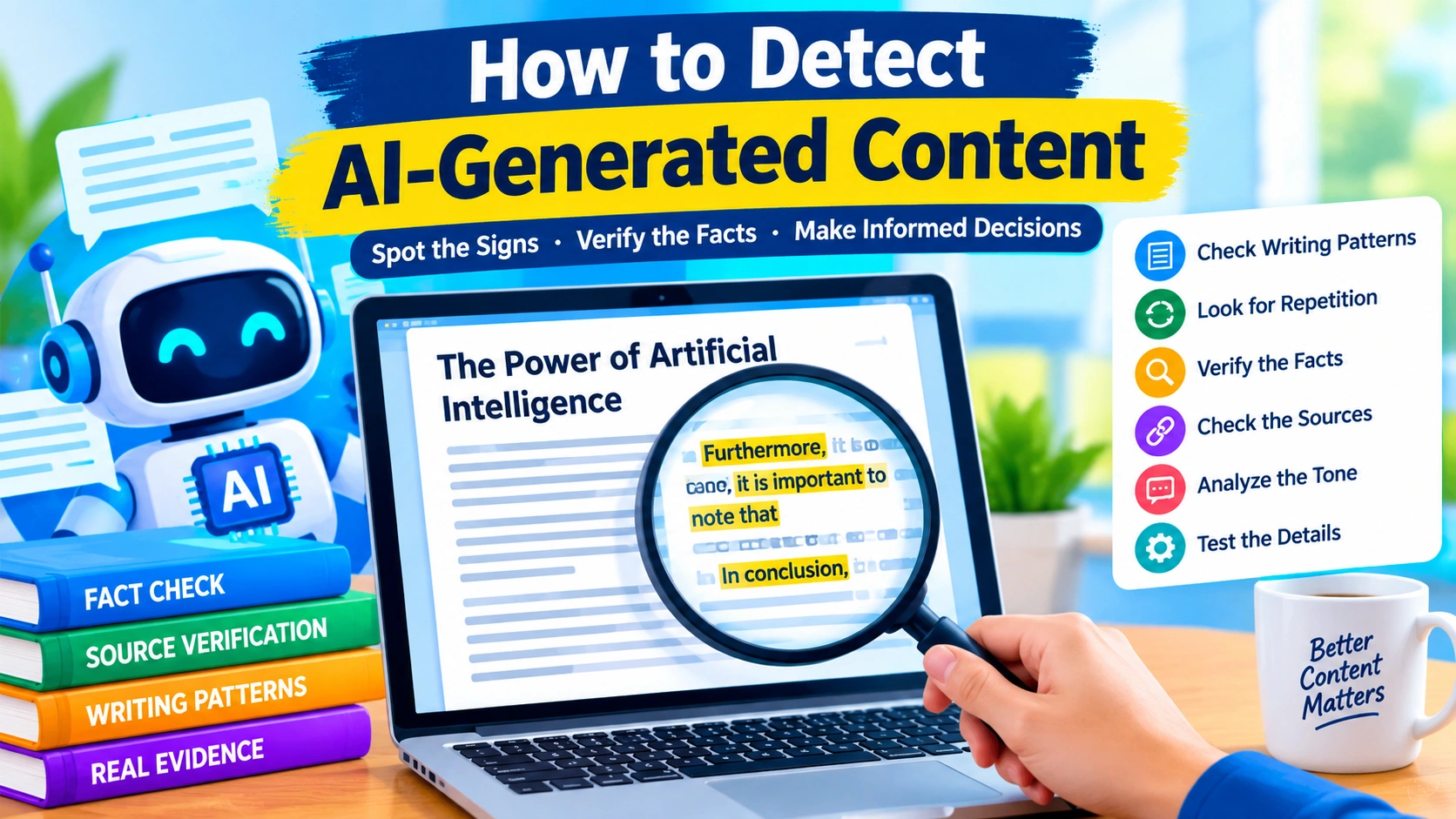
AI can be useful, but it has limitations.
Don’t Assume AI Is Always Correct
AI can produce incorrect information with convincing wording. A confident answer does not automatically mean the information is accurate.
Don’t Trust Unverified Citations
If an AI tool provides a citation, open the source and verify that it exists and actually supports the statement.
Don’t Use One Source for Everything
A single source can contain errors or incomplete information. Important claims should be checked against appropriate authoritative sources.
Don’t Ignore Context
A statement may be technically correct but misleading when taken out of context. Check the surrounding information and the circumstances in which the claim was made.
Don’t Treat Opinions as Facts
AI may summarize opinions, predictions, or interpretations alongside factual information. Clearly separate evidence-based facts from personal opinions and speculation.
Best AI Workflow for Research
A reliable AI research workflow can be divided into five stages:
Research → Identify → Verify → Compare → Document
Research
Use AI to explore the topic and identify important questions.
Identify
Separate factual claims, opinions, assumptions, and questions that require additional evidence.
Verify
Check important claims against primary and authoritative sources.
Compare
Review multiple sources and investigate disagreements.
Document
Record the sources, dates, evidence, and conclusions so the research can be reviewed later.
AI vs Traditional Fact Checking
AI and traditional research methods work best together.
| AI Assistance | Human Verification |
|---|---|
| Finds research directions | Selects trustworthy sources |
| Summarizes information | Checks original documents |
| Organizes notes | Evaluates evidence |
| Identifies questionable claims | Confirms or rejects claims |
| Compares large amounts of text | Understands context |
| Generates research questions | Makes the final judgment |
AI is particularly useful for speed and organization, while human review remains essential for accuracy and context.
Tips for Better AI Research Prompts
The quality of an AI response often depends on how clearly the task is described.
Instead of asking:
“Is this information true?”
Try:
“Analyze this claim, identify what evidence would be needed to verify it, and explain which types of authoritative sources should be checked.”
You can also ask AI to separate its response into:
- Verified information
- Information requiring verification
- Uncertain claims
- Sources to investigate
- Possible contradictions
This makes the research process more systematic.
Protect Your Privacy During AI Research
Avoid entering confidential or sensitive information into AI tools unless you understand how the service handles that information.
When researching, consider removing:
- Passwords
- Private documents
- Personal identification information
- Financial information
- Confidential business data
- Private communications
Use publicly available information whenever possible for general research tasks.
Frequently Asked Questions
Can AI be used for fact checking?
Yes. AI can help identify claims, summarize evidence, compare information, and suggest sources to investigate. However, important claims should be independently verified using reliable sources.
Can AI make mistakes during research?
Yes. AI can generate inaccurate, outdated, incomplete, or misleading information. Always verify important facts against trustworthy sources.
What sources are best for fact checking?
Primary and authoritative sources are generally preferable, including government agencies, universities, scientific publications, official documentation, original datasets, and reputable news organizations.
Should I trust AI-generated citations?
No citation should be trusted automatically. Open the cited source, confirm that it exists, and check whether it actually supports the claim.
Is AI replacing human fact checkers?
AI can automate parts of the research and verification process, but human judgment remains important for evaluating source quality, context, conflicting evidence, and complex claims.
Final Thoughts
AI for Research and Fact Checking can make information gathering faster and more organized, but AI should support—not replace—critical thinking. The most reliable approach is to use AI to discover information, organize research, identify claims, and suggest questions while independently verifying important facts.
For high-stakes information, always consult authoritative sources and examine the original evidence before accepting a claim as true. Combining AI assistance with careful human verification provides a much stronger research process than relying on AI alone.